


Getting Started With ChatGPT Advertising
A practical guide for businesses evaluating ChatGPT advertising—from online sales and software subscriptions to B2B opportunities and service bookings.
By Activate Digital Media
Yes, businesses can advertise on ChatGPT through OpenAI Ads Manager in supported markets. Getting started involves checking eligibility, preparing an offer and destination page, choosing a campaign objective and budget, creating ads, setting up measurement, and submitting the campaign for review. OpenAI’s launch guide explains the platform workflow.
This guide explains costs, setup, product feeds, and measurement so you can plan a test around your business goals—profitable orders, paying subscriptions, qualified opportunities, or bookings. Define the outcome you need before deciding how to advertise.
What Are ChatGPT Ads?
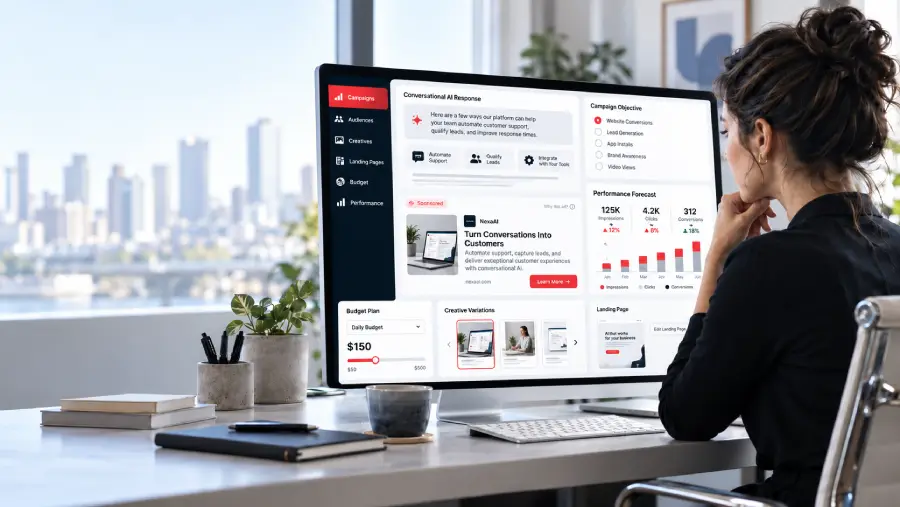
ChatGPT Ads are sponsored placements that can appear below a response, separate from the answer itself. An ordinary ad includes the advertiser’s identity, headline, description, image, and destination page. See OpenAI’s advertiser basics.
Buying an ad does not buy influence over ChatGPT’s answers or an OpenAI endorsement. OpenAI also says advertisers do not receive users’ private chats or memories. Read its explanation of ads and privacy.
Keep three activities separate: running paid placements, improving organic AI-search visibility, and using AI tools to write advertising copy. Paying for the first does not purchase the second; doing the third does not automatically place an ad anywhere.
For a business owner, that means the offer must stand on its own. “ChatGPT recommends us” is not an appropriate substitute for a clear reason to buy or inquire.
Which Businesses Should Consider ChatGPT Advertising?
Our recommendation is to assess the customer decision, not restrict the channel to one industry. Is there a problem your offer solves, a meaningful choice to explain, and a next step that can be measured?
E-Commerce and Retail
Consider a furniture retailer promoting desks for compact home offices. The useful question is whether the ad can bring relevant shoppers to a collection with clear dimensions, pricing, availability, and shipping information. Evaluate completed orders and margins, not just product-page visits.
B2B and Professional Services
A commercial supplier might build a campaign around a particular buying requirement, with a destination that explains specifications and how to request a quote. A professional-service firm could focus on a defined business problem rather than a broad “we do everything” message. Track qualified opportunities and the sales cycle that follows.
Software and Subscriptions
A software provider might promote one use case to people comparing ways to manage a workflow. A trial or demo can be a sensible first conversion, but the business still needs to know whether users activate and become paying customers. Do not value every sign-up as a subscription.
Local, National, and Multi-Location Businesses
A service company may focus on appointments, while a national brand may test demand for a new offer across supported markets. Match the destination and follow-up to the customer’s location when that matters. Do not narrow a nationwide product campaign to a local-service template—or assume a local business can fulfill demand everywhere.
These are illustrative planning examples, not client case studies, promised results, or an exhaustive list of businesses that can use the channel. Eligibility depends on the advertiser, offer, market, and platform rules.
ChatGPT Ads Eligibility and Audience
Self-service access depends on where the billed legal entity is based. The United States and other listed markets are supported.
Some new self-service accounts initially advertise only in their home country; international access depends on approved identity verification and required advertising spend. Creating an account does not override country restrictions; check the current availability list before planning a launch.
Advertiser eligibility is different from audience reach. OpenAI says ads may appear on Free and Go plans, while Plus, Pro, Business, Enterprise, and Edu accounts remain ad-free. Its user-facing ads guidance explains these distinctions.
For B2B advertisers, our planning implication is important: do not assume your campaign can reach every professional using ChatGPT at work. Assess the reachable audience and your own results rather than treating total platform usage as advertising inventory.
How Much Do ChatGPT Ads Cost?
There is no single flat price that applies to every campaign. Separate the platform’s billing model, your media budget, and the cost of managing the campaign.
How Platform Billing Works
OpenAI currently offers Views, Clicks, and Conversions objectives. Views uses impression-based billing; Clicks uses valid-click billing. Conversion-optimized campaigns can use supported click- or impression-based billing. Choosing Conversions does not mean paying only when someone buys or becomes a lead. See OpenAI’s campaign-objective guidance.
Minimum Daily Budget
OpenAI currently lists a USD 25 minimum daily campaign budget for USD accounts. Other currencies have their own minimums, and additional bid-related constraints can apply. That is a platform setting—not an ADM management price or evidence that the minimum will fund a useful test. See OpenAI’s budget guidance.
Daily Budgets and Spending Limits
Under OpenAI’s published daily-budget rules, spend can reach twice the selected amount on an individual day, with a seven-times limit over the applicable Sunday–Saturday budget week in the ad account’s time zone for an unchanged budget. Changes are subject to proration.
A campaign-total budget provides a stricter total-spend control. Review the displayed limits and schedule rather than assuming each day will cost exactly the same amount.
Account for the Complete Investment
Your working budget should distinguish:
- Media spend.
- Campaign management.
- Creative.
- Landing-page work.
- Measurement and integration costs.
Ask which items are included and which are separate. A low advertised management fee is not the total acquisition cost.
A useful first test is sized around a business question. A retailer evaluating orders, a software company evaluating activated trials, and a B2B firm with a long sales cycle will not necessarily need the same budget or evaluation window.
How to Advertise on ChatGPT
1. Confirm Eligibility and Account Ownership
Start with OpenAI’s account-setup guide. Use an existing advertiser account when one already exists, and invite the people who need access rather than duplicating accounts. Review business details, billing, permissions, and any required verification.
For planning without immediate delivery, use the setup path that skips ad creation. OpenAI warns that ads submitted during signup can begin running after approval when delivery requirements are met. Do not submit a campaign merely to explore settings when you are not ready to spend.
2. Choose One Business Outcome to Prioritize
Write a sentence such as: “We want to learn whether this offer can acquire new customers at a cost our margins support.” Then define the action you will measure first and the downstream result you will use to evaluate it.
Match the first action to the result that matters:
- Store: completed orders, followed by net sales after returns.
- Software: trial registrations, followed by activation and paid conversion.
- B2B: qualified requests, followed by sales-accepted opportunities.
- Appointment business: confirmed bookings, followed by attendance and completed purchases.
These are business measurement choices. Select the platform objective and supported event that best fit the plan; not every CRM stage is automatically an available optimization event.
3. Build Focused Ad Groups and Context Hints
OpenAI describes context hints as additional information about what you offer, whom it helps, and when it may be useful. They are relevance signals, not exact-match keywords or rules guaranteeing delivery to specific conversations. See its ad-group guidance.
A hypothetical hint for a furniture brand could describe “compact desks for adults furnishing a small home office.” A software example could describe “project planning tools for teams coordinating client deliverables.” These examples describe an offering; they do not claim access to a person’s private discussion or promise where the ad will appear.
Separate offers when their message and destination differ meaningfully. Keep your first structure understandable enough that a result can be tied back to a coherent proposition.
4. Match the Ad to the Destination
OpenAI recommends specific, benefit-focused creative and relevant landing pages. See its ad-creation guidance. Our practical test is simple: after clicking, can someone immediately find the offer that interested them?
Match each offer to a useful destination:
- Product category: an appropriate product or collection page.
- Demo: an explanation of what the demo covers and how to request it.
- Booking: clear availability and the next step.
Prepare genuinely different messages, not five nearly identical headlines. You might test the problem solved, a useful product attribute, and the process or support offered. Use only claims your business can substantiate. Test mobile usability, page speed, checkout or forms, and confirmation messages before launch.
5. Set Up and Test Conversion Measurement
OpenAI supports the Pixel, Conversions API, or both for conversion measurement. Events must align with campaign configuration. When the same event is sent through both methods, the event ID supports deduplication.
Preserve available click references and follow the platform’s disclosure and consent requirements. See OpenAI’s conversion-measurement guide.
Test an actual completed action, not only whether a script loads:
- Can the order be found in the store?
- Did the form reach the right inbox or CRM?
- Did the booking complete?
Label test transactions so they are not mistaken for customer results.
6. Review the Launch Controls
Before submitting, check:
- Approved creative and destination pages.
- The campaign objective, budget, and schedule.
- Available location settings and account readiness.
- Conversion measurement and completed-action tests.
For campaigns other than new product-feed campaigns, supported subnational targeting may be available; geographic choices vary by country. Confirm the exact configuration rather than relying on a city name in the copy.
After submission, verify platform review status and actual delivery. OpenAI’s launch checklist distinguishes campaign creation from a campaign that is ready and serving. Keep a record of the initial configuration so later changes can be evaluated.
Can E-Commerce Businesses Run Product-Feed Ads?
Yes. OpenAI supports retail campaigns built from product catalogs. Its product-feed guide explains feed setup, product selection, and ad templates.
New product-feed campaigns currently use country-level geographic targeting; a product label is not a geographic delivery restriction. Uploading an advertising feed also does not place those products in organic ChatGPT conversations.
Our recommendation is to choose products deliberately. Prioritize a coherent group you can fulfill, with accurate product data and a useful buying experience. A large catalog is not automatically a reason to promote every item at once.
Keep product eligibility, stock, pricing, product pages, shipping coverage, and measurement aligned. Decide who will maintain the feed after launch, and include that work in the management scope.
Feed items expire after two weeks, so plan regular updates through a hosted feed URL or automated SFTP uploads. Store-only offers should not assume the same geographic controls as other campaign types.
How to Decide Whether the Results Are Worthwhile
Start with the result your business needed, then work backward to the delivery metrics. A low click cost is encouraging only when those visits contribute to something valuable.
Evaluate results using the economics of your business:
- E-commerce: compare acquisition costs with contribution after product costs, fulfillment, fees, discounts, and returns.
- Subscriptions: separate realized value from projections and account for cancellations.
- B2B and services: evaluate qualification, close rates, and the time needed to turn an inquiry into business.
Two Hypothetical Break-Even Examples
These examples are planning arithmetic, not ChatGPT benchmarks, ADM results, recommended budgets, or performance forecasts. Assume the orders or customers described are genuinely additional.
An online store retains $40 per order after the direct and variable costs of fulfilling it. A test costing $1,200 in total would need 30 additional orders to cover that investment: $1,200 divided by $40. That is before any desired profit beyond break-even or unallocated fixed overhead.
A B2B business retains $500 in contribution per new customer and converts 20% of qualified opportunities. The break-even acquisition allowance is $100 per qualified opportunity: $500 multiplied by 20%. If management and creative consume part of that allowance, the available media cost per opportunity is lower.
Change the assumptions and the answer changes. Use your own margins and qualification rules; do not borrow another industry’s cost-per-lead target. Channel attribution identifies credited outcomes, not proof that every credited customer was caused by the ad.
Read Platform Reporting Carefully
OpenAI reports impressions, clicks, spend, and attributed conversions. The conversion total can include different events and eligible view-through credit depending on reporting settings. Select the event columns and attribution settings needed to understand the result; see OpenAI’s reporting guide.
Recent totals can also change as data is processed. Document the reporting period and compare like-for-like windows before making decisions. Do not add totals from several ad platforms and assume the sum represents unique customers.
ChatGPT Ads vs. Google Ads and Organic AI Visibility
Give each activity a clear job:
- Paid search: continue evaluating the customers an established campaign produces.
- Organic search and AI visibility: improve discoverability without purchasing the same paid placement.
- ChatGPT Ads: run a test with its own budget, goals, and evaluation criteria.
Do not pause a productive channel solely to chase novelty. Equally, do not dismiss a new channel because its buying process differs. Compare offers, customer quality, acquisition costs, and attribution assumptions. The useful question is where the next investment has the strongest evidence—not which platform has the newest name.
Common Mistakes to Avoid
A campaign can be technically live and still be poorly designed. Watch for:
- A broad offer with no clear customer need.
- A generic homepage that does not match the ad.
- Untested conversion events.
- A budget split across too many unrelated tests.
Do not interpret a few cheap clicks as proof of a profitable channel, or a handful of days as a definitive failure. Review delivery and technical issues early, then allow an evaluation window appropriate to the purchase cycle and available data. Set review criteria before spending so the interpretation does not change to fit a preferred conclusion.
Questions Businesses Ask About ChatGPT Advertising
Self-service access is not described as an enterprise-only offering. Check the advertiser’s country and setup requirements, then assess whether a test fits the business’s resources. A minimum budget is not a recommendation that every small business should spend it.
OpenAI’s account setup supports inviting users with different roles. The business should keep appropriate account access, understand billing responsibility, and approve the scope and spending. An agency relationship does not bypass platform reviews or eligibility rules.
Context hints do not guarantee delivery against an exact prompt. Use them to explain relevance and assess outcomes instead of selling a promise that a particular conversation will trigger your ad.
There is no universal answer. OpenAI says established performance benchmarks across advertisers, industries, and campaign types are not yet available. Use its advertiser FAQ for that context, then compare your own qualified outcomes and complete costs rather than assuming a new platform is less expensive.
No. Consider a test when eligibility, offer quality, customer economics, measurement, and operational capacity support one. First fix a broken checkout, unanswered inquiries, an unclear offer, or missing measurement. Those problems make any acquisition experiment harder to evaluate.
Plan Your ChatGPT Ads Campaign
The best starting point is a specific offer, a relevant customer need, a useful destination, and a way to recognize success. That framework works whether you sell products, software, professional expertise, or appointments.
Activate Digital Media can help you assess the opportunity and define a managed campaign scope connecting strategy, creative, landing pages, and measurement. Tell us what you sell, where you operate, and which outcomes you want to improve.
Ready to Grow Your Business?
Contact us to work with a result-driven digital marketing agency. Are you ready to take your business and online marketing to the next level.
Get Your Free Marketing Plan →