


What an AI Brand Accuracy Audit Checks About Your Business
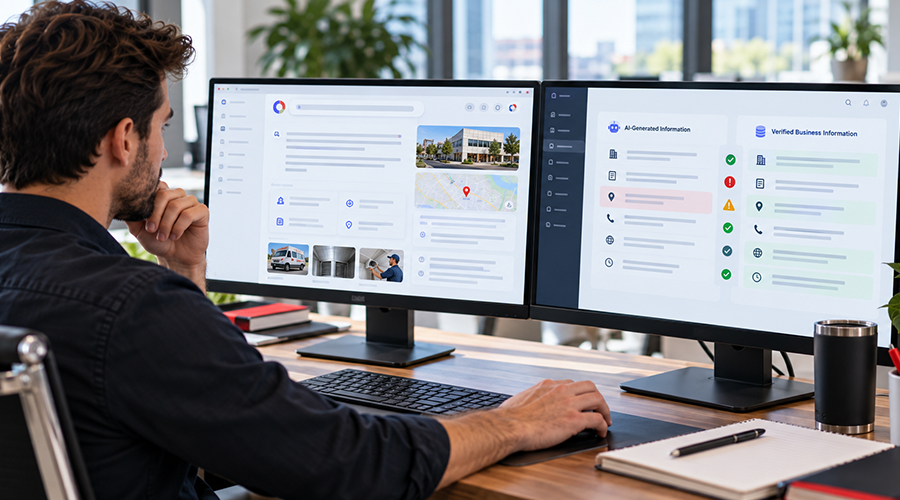
An AI answer can name your business but still give a customer the wrong phone number or service area. An AI brand accuracy audit checks those claims against current, approved evidence. It also examines relevant discovery questions and whether important website pages are eligible to be found.
Use the findings to record:
- What needs correction.
- The evidence supporting it.
- The person responsible.
- The date for checking again.
For a business serving Houston or The Woodlands, the questions are concrete.
- Does the answer identify the right company?
- Does it describe services available from the local team?
- Does it send customers to the correct phone number?
- Does it make a limited offer sound available everywhere?
This guide combines accuracy and discoverability checks in one workflow. It supports a broader generative engine optimization strategy while keeping the focus on information customers use to choose a business.
Distinguish Mentions From Accuracy
Use consistent definitions before scoring the results. These are working definitions for your audit, not official platform metrics.
| Audit measure | What to record |
|---|---|
| Brand mention | The correct business is named in an answer. |
| Recommendation | The answer presents the business as an option for the stated need. |
| Cited URL | A displayed source link points to your website or another page discussing you. |
| Factual accuracy | Material claims match current evidence, including important conditions. |
| Completeness | The answer preserves qualifications needed for the customer's decision. |
| Referral visit | Analytics identifies a website visit arriving from an AI source. |
| Qualified lead | An actual inquiry matches your service, territory, and customer requirements. |
An answer with the wrong phone number needs attention even when it includes your name and website. A citation to a national brand page may leave someone without the local booking information they need.
Likewise, an answer that does not recommend your company is not automatically inaccurate. The requested location, service, or availability may fall outside what you offer. Keep that difference in fit separate from a factual error.
1. Prioritize Customer-Decision Facts
Start with ten facts that influence whether customers contact or choose you. Priorities vary:
- Home-service company: Territory, service scope, emergency availability, and booking.
- Professional firm: Qualifications, office locations, practice areas, and consultation terms.
Choose three to five commercially important services and the areas where you want appropriate inquiries. Ask operations to confirm the territory and any differences by service. A company may accept residential appointments across a wider area than certain commercial projects.
Pay attention to the promise a customer would reasonably understand. “Accepts requests online anytime” and “dispatches technicians around the clock” describe different commitments. “Commercial projects considered after assessment” should not become an unconditional promise to handle every property.
2. Build an Approved Business Fact Sheet
Create one shared reference before testing. Marketing can coordinate it, but the people responsible for delivery should approve operating facts.
| Fact group | Information to confirm | Evidence to retain |
|---|---|---|
| Identity | Public name, official website, parent or franchise relationship | Current company and location records |
| Location | Offices actually operated, customer access, appointment requirements | Approved location information |
| Territory | Cities, ZIP codes, exclusions, service-specific limits | Service-area page and operations confirmation |
| Services | Included and excluded work; residential and commercial scope | Current service pages and approved scope |
| Availability | Office hours, phone coverage, appointments, emergency response | Current policies and booking workflow |
| Offers | Price conditions, eligibility, participating locations, expiration | Approved offer or pricing record |
| Credentials | Qualifications, memberships, certifications, relevant dates | Issuer or other authoritative record |
| Contact | Correct number, booking link, form destination | A tested contact route |
Give each fact an owner and a “checked on” date. Verify it against internal records, but keep confidential customer and commercial information out of public prompts. Decide separately what approved clarification belongs on the website.
For franchises, maintain a corporate section plus a section for each location. This helps identify answers combining one branch's offer with another branch's address. Preserve local restrictions even when the national website describes a broader capability.
Google's Business Profile guidelines require accurate business representation and precise addresses or service areas. Check your published profile against the same approved facts.
3. Separate Discovery and Branded Tests
Discovery questions represent customers who need a provider but have not selected a company. Branded questions investigate a business the customer already knows.
Build a small question set from sales calls, inquiry forms, and customer conversations. Twelve to twenty prompts can be a manageable starting workload. This is an operating suggestion, not a statistically validated sample size.
For example, an agency audit could include:
- Discovery: “Which agencies provide local SEO services in The Woodlands?”
- Comparison: “What should a Houston home service company compare when choosing an SEO agency?”
- Branded: “Does Activate Digital Media work with franchise businesses?”
These are sample audit questions, not reported search results. For your own business, add branded questions about service scope, territory, availability, contact details, and offer conditions.
Use Houston and The Woodlands as separate variants when the buying decision changes by area. A city written in a prompt supplies geographic context. It does not reproduce a customer's GPS position or constitute a local map ranking test.
- Keep discovery prompts free of your company name.
- Avoid leading questions that assume you are the best provider.
- Also keep the approved fact sheet out of the baseline conversation; supplying it first changes what you are testing.
- An experiment that supplies evidence can be useful later, with its own label and records.
4. Record Answers and Test Conditions
Create a new observation for every test. Use fresh conversations and record:
- The exact prompt and its version.
- Platform, product, mode, date, time, and language.
- Model name or search setting when displayed; otherwise, “not shown.”
- Stated location, visible location settings, sign-in status, and personalization settings.
- Whether the relevant AI answer appeared.
- The complete answer, businesses mentioned, and displayed sources.
OpenAI explains that location and saved memories can influence search. A fresh conversation alone does not remove every contextual influence. Record the conditions you can observe and acknowledge the ones you cannot control.
Save enough of the answer to preserve its meaning. A cropped image of your business name can omit an incorrect qualification in the following paragraph. Open source lists when available and retain the links you actually inspected.
Repeat important questions on three separate dates for an initial baseline. Keep ChatGPT web search, Google AI Mode, and Google AI Overviews in separate groups. If you change the prompts or a visible product mode changes, annotate it.
These observations can expose inconsistencies. They cannot establish a universal probability of appearing across all users. Preserve both the earlier and later responses when a result changes.
5. Classify Claims Against the Evidence
Break each answer into checkable statements. One sentence may make several claims about location, services, customers, and booking.
Use five labels:
| Classification | Meaning |
|---|---|
| Supported | Current evidence confirms the claim and its important conditions. |
| Contradicted | Reliable current evidence conflicts with the statement. |
| Outdated | The statement describes a fact that has been superseded. |
| Unresolved | Available evidence is insufficient to decide. |
| Misleading omission | A missing qualification changes the likely customer interpretation. |
Record subjective positioning separately. “Friendly company” is an opinion, while “open until 8 p.m.” is a checkable operating claim. Your preferred marketing description is not automatically the only accurate description.
An unresolved claim calls for investigation. Do not mark it false merely because the marketing team cannot immediately find a document confirming it.
Illustrative Example: A Dryer Vent Company
Consider a hypothetical company serving The Woodlands and selected areas of north Houston. It handles residential cleaning and assesses commercial properties before accepting a project. Its online request form is available anytime, while technicians work scheduled appointments.
The following are fictional audit findings used to demonstrate the worksheet:
| Statement being reviewed | Evidence finding | Classification and next action |
|---|---|---|
| “The company serves The Woodlands.” | The approved territory includes it. | Supported: retain the evidence. |
| “Technicians are available 24/7.” | Only the request form operates around the clock. | Contradicted: clarify response and appointment hours. |
| “The company offers an introductory package.” | The offer applies to one branch. | Misleading omission: put eligibility beside the offer. |
| “It offers a lifetime warranty.” | No verified warranty record has been located. | Unresolved: ask operations before drawing a conclusion. |
| A displayed phone number reaches a former office. | A current contact test confirms a different destination. | Outdated: correct the published number and test routing. |
For commercial discovery, the audit might ask which providers assess apartment dryer vent systems in north Houston. The useful follow-up is to check whether the company's actual commercial scope and quote process are explained clearly. A mention outside its territory would not count as a qualified opportunity.
6. Match the Correction to the Source
Open the cited page and find the passage supporting the disputed statement. Confirm that it concerns the correct business and branch, remains current, and includes the conditions the answer should preserve.
Choose the response that matches the evidence:
- Your page contains an error: correct the fact and other affected pages.
- Your page is ambiguous: explain the distinction in ordinary customer language.
- An outside page is incorrect: request a factual correction from its owner, supplying evidence.
- The source is accurate but the answer misstates it: save both and use the platform's feedback process where available.
- No supporting source is visible: record the source as unavailable and the cause as unconfirmed.
Google provides feedback options for AI Overviews. A submitted report is evidence of a feedback action, not confirmation that the issue has been corrected.
Do not assume every stale statement comes from model training. Conflicting pages, unclear identity, omitted conditions, or incorrect inference may need different remedies. Choose the correction supported by the evidence.
7. Check Discoverability and Eligibility
An accuracy review should also establish whether important service and location pages can participate in search.
Google's AI optimization guidance requires eligible pages to be indexed and available with a snippet, with the site included through Search Console's generative AI control. Google does not require special AI schema or use llms.txt to improve Search visibility. Eligibility does not guarantee inclusion.
Ask the web team to document the status of priority pages and verify fixes for any access or indexing problems. For franchises, check whether the relevant property inherits its inclusion setting from a parent property. Google's control documentation explains inheritance and overrides.
For ChatGPT, OpenAI's guidance calls for access by OAI-Searchbot and its published searchbot IP addresses. Have the team check both crawler permission and hosting access.
Keep these findings distinct from accuracy classifications. An accessible page can contain the wrong facts; an accurate page can still have a discovery problem.
8. Correct Relevant Customer Pages
Put the clearest approved explanation where it answers the customer's immediate question: service limitations on the service page, territory on the appropriate location page, and eligibility beside the offer.
For the hypothetical dryer vent company, the commercial page could explain accepted property types, who should arrange access, what information is needed for a quote, and when an assessment is required. Add original project evidence only when it is verified and appropriate to publish.
Coordinate business profile changes with the authorized account owner. A website correction should trigger a check of the corresponding profile field so the two do not continue to conflict.
Where appropriate, Organization structured data can help Google understand business identity and administrative details. Keep it aligned with the actual organization and public information.
Improve the relevant existing page when it can fully answer the question. Creating another broad article may leave the original misleading service statement in place. Give each correction a clear destination and customer purpose.
9. Assign an Owner and Define Completion
Use an issue log that separates publishing a correction from observing a corrected answer.
| Field | What to record |
|---|---|
| Issue | Exact disputed claim, affected prompt, platform, and date |
| Customer impact | Wrong destination, unavailable service, incorrect terms, or another consequence |
| Evidence | Approved fact and supporting public URL or internal record |
| Owner | Person responsible for the website, profile, operations decision, or publisher request |
| Status | Investigating; correction prepared; published; recheck pending; observed resolved |
| Verification | Live corrected page, tested contact route, dated retest, remaining variation |
Prioritize wrong contact details, misleading availability, unavailable services, and promises the business cannot honor. Then address stale descriptions and less consequential positioning gaps.
For a contact correction, test the destination. Confirm that the phone or form reaches the intended team and that the information staff provide agrees with the published explanation.
A practical first-month schedule is to approve facts in week one, capture the baseline in week two, publish priority corrections in week three, and repeat the original tests in week four. Handle urgent customer-facing errors as soon as they are verified.
Google offers methods for requesting recrawling, but processing and inclusion are not guaranteed. Track three milestones separately: the correction is live, a system has revisited it where verifiable, and a subsequent answer reflects it.
Report Findings and Remaining Work
A monthly readout should show saved observations, supported and problematic claims, unresolved high-impact issues, corrections published, and outcomes of repeated tests. Keep platforms and modes separate.
- For an internal accuracy percentage, one option is supported claims divided by supported, contradicted, and outdated claims.
- Label this as accuracy among resolved factual claims, not an overall audit score.
- Show raw counts and report unresolved claims and misleading omissions separately.
- An absent business has no accuracy finding for that response; do not treat absence as a correct answer about it.
For visibility, retain both the number of attempted tests and the number that displayed the relevant AI answer. State which denominator any inclusion percentage uses. This distinguishes changes in answer availability from changes in your sampled mentions.
Google's Generative AI performance report provides link impressions from AI Overviews and AI Mode, with page, country, date, and device dimensions. It does not provide a query dimension or verify answer accuracy. A report may be absent when impressions are insufficient.
GA4's AI Assistant channel identifies visits with recognized assistant referrers. Google AI Overviews and AI Mode visits remain under Organic Search.
- Use CRM or booking records to determine which identified inquiries qualified and booked.
- Deduplicate multiple calls and forms about the same inquiry.
- Preserve a customer's self-reported discovery source alongside the measured source when they differ.
- Call and form tracking can support that reconciliation.
Frequently Asked Questions
The work overlaps. This audit produces evidence about AI answers, factual corrections, and search eligibility. A broader local SEO audit also investigates local discovery and performance. Share relevant findings between the two workflows while tracking accuracy and visibility separately.
You can publish clear, supportable information and correct sources you control. Platforms may still describe your business differently. Judge whether the identity, services, and qualifications remain accurate. The audit should document improvements you can verify without promising a particular placement or wording.
Set a review date and continue monitoring important issues. A live correction does not establish that a later answer will use it. Repeat the original prompt under comparable conditions and preserve both responses. Escalate continuing customer-impacting errors with the available evidence.
Only when evidence identifies a factual problem. A customer's opinion can be unfavorable without being false. Record the precise statement and disputed fact. A wrong address, invented credential, or misidentified company requires a different response from a legitimate criticism.
Yes. An approved fact sheet, a small prompt set, saved answers, and a spreadsheet can support a first audit. Add software when locations and testing volume make records difficult to maintain. Keep underlying evidence available so every score and recommendation can be explained.
Turn the Audit Into an Improvement Plan
If your Houston or The Woodlands business needs help checking its AI descriptions, service information, and discoverability, contact Activate Digital Media. Bring your website, target locations, priority services, and saved answers that concern you. Those provide a concrete starting point for an audit and a measurable correction plan.
Ready to Grow Your Business?
Contact us to work with a result-driven digital marketing agency. Are you ready to take your business and online marketing to the next level.
Get Your Free Marketing Plan →